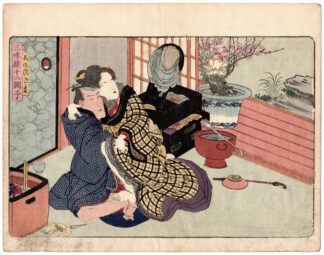
An original Japanese woodblock print can be identified by examining its handmade washi paper, pigment absorption, keyblock line sharpness, and historical publisher or censor seals. Unlike modern offset reproductions or digital prints, authentic woodblock prints show ink pressed deeply into mulberry fibers, slight back-of-sheet bleed-through, and subtle tactile impressions left by the printer’s baren.
Because popular designs by masters such as Hokusai, Hiroshige, and Kunisada were reprinted across different decades, distinguishing an early period impression from a later restrike or mechanical copy requires looking closely at physical and historical clues. Understanding these details helps collectors evaluate authenticity and build a meaningful collection of original ukiyo-e woodblock prints.
Inspect the Washi Paper and Ink Penetration
Traditional Japanese prints were pulled on washi, a resilient paper crafted primarily from the inner bark of the kozo (paper mulberry) plant. Holding an authentic print toward a light source reveals organic, interwoven fibers and subtle variations in thickness rather than the uniform smoothness of modern wood-pulp paper.
Water-based pigments mixed with rice paste soak directly into these fibers instead of sitting on the surface. Turning the sheet over provides a crucial test: on a genuine woodblock print, traces of color and crisp black outlines (sumizuri-e) partially penetrate to the reverse side, whereas modern lithographs or inkjet copies leave the back completely blank.
Look for Physical Signs of Hand Printing
Every authentic woodblock print carries subtle evidence of manual production. During printing, the artisan pressed dampened paper onto carved cherrywood blocks using a circular bamboo-sheathed pad called a baren. On the reverse of the sheet, this circular rubbing motion often leaves faint, swirling burnish marks.
Along the margins, collectors can also spot tiny notches or right-angle marks left by the kento registration system, which aligned each color block with precision. Early impressions sometimes also display karazuri (blind embossing), where uninked carved blocks were pressed into the paper to create raised textures on kimono fabrics, waves, or snow.
Check Signatures, Publisher Marks, and Censor Seals
Historical prints from the Edo (1603–1868) and Meiji (1868–1912) periods typically feature documentary markings printed directly within the composition or margins to confirm period authenticity and publication date:
- Artist signature (rakkan) and seal: usually placed inside a vertical cartouche, identifying the designer of the composition.
- Publisher mark (hanmoto): a distinctive emblem indicating the commercial house that financed and distributed the edition.
- Censor seals (kiwame or aratame): official approval stamps required on most commercial prints from the late eighteenth century through the 1870s.
While twentieth-century sosaku-hanga creative prints replaced commercial seals with pencil signatures and edition numbers, authentic Edo and Meiji prints rarely lack proper publisher and/or censorship documentation.
Compare Line Sharpness and Color Registration
In a genuine early woodblock edition, the black keyblock lines appear crisp, tapered, and alive with calligraphic energy. Because wooden blocks wore down after hundreds of impressions, late restrikes often show broken outlines, thickened details, or gaps where color blocks no longer align cleanly with the keyblock.
By contrast, mechanical reproductions reveal uniform halftone dot patterns under a jeweler’s loupe rather than continuous washes of water-based pigment.